
It Looked Real. So I Went Back and Investigated.
by Cary and Patty ~ My Simply Sage
Recently I wrote about getting caught by a very professional-looking online offer involving AI tasks and making money. It cost me $147 before the little voice in my head finally got loud enough to say whoa. Here’s a little follow-up that I did
The bank had been contacted and the charge was pending so I really couldn’t do anything just yet. I had to wait until it actually got posted as a charge, not pending, posted. Bank rules. Ok, so I figured that was pretty much the end of the story.
It wasn’t.
A few days later I noticed an email from the same outfit—I’ll call it “Cary’s Money Maker” here—had shown up in SPAM. Instead of deleting it and moving on, I decided, wait, wait a minute, let’s check this out. Carefully.
I investigated.
Not recklessly. No more money. No downloads. No giving them additional information. And definitely no clicking “Accept” on anything I didn’t understand. I looked.
And I had some help.
I had another tool sitting right here on my computer:
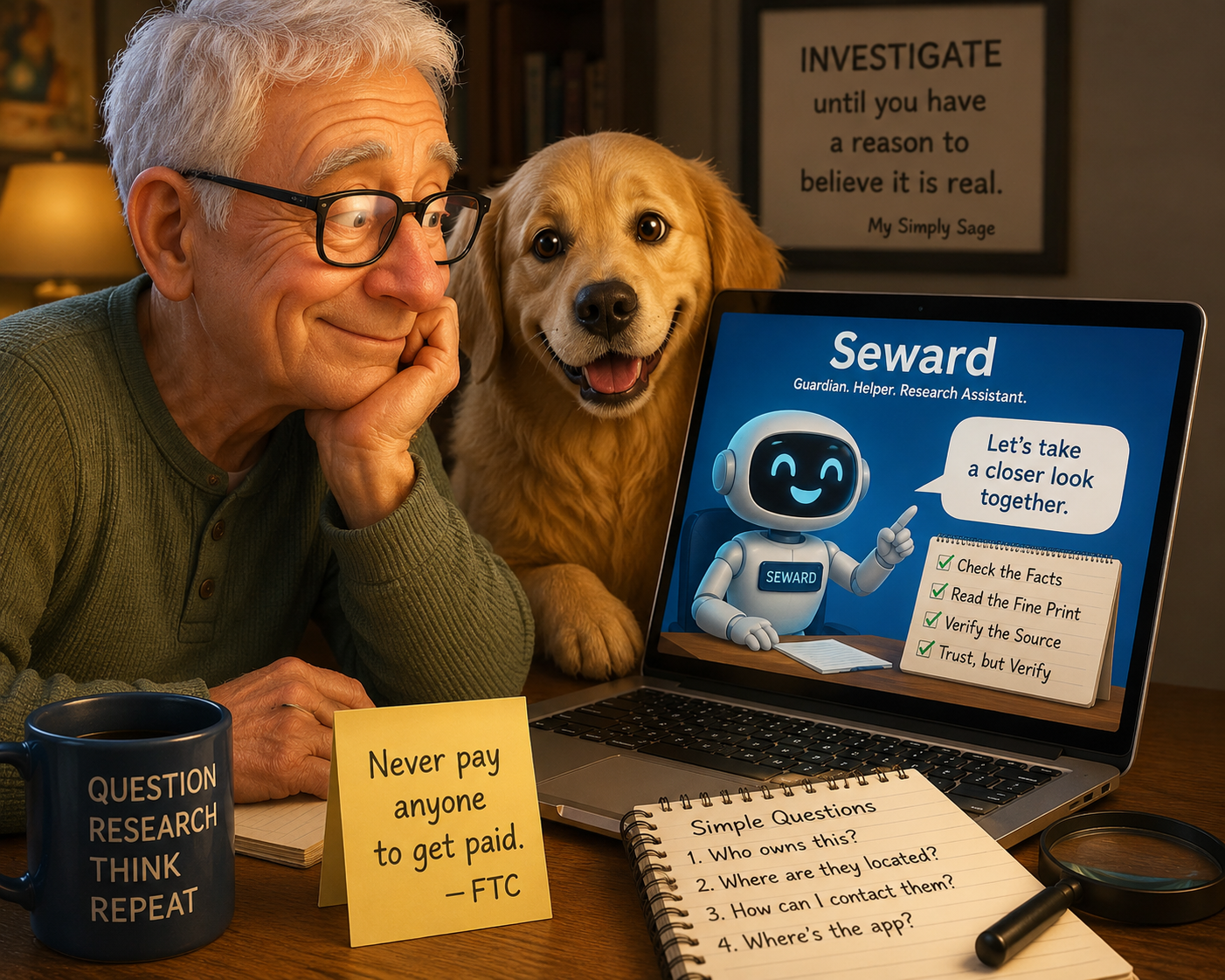
My buddy Seward.(Seward)— my name for ChatGPT. (And yes, there’s a reason for his name. Seward basically means “guardian” or “protector.” Seemed appropriate.)
So we started looking.
Looking behind the pretty website, Cary’s looked good, so I took a chance and went into their site through the link. Ya, a bit dangerous—and not something I recommend as the best way to investigate—but I was already there, so I looked. Well look at this. Professional logo. Clean website. Terms of Service. Privacy Policy. Refund Policy. Legal-looking language. All the things that make our brains say, “Well, this must be legitimate.” But having those things doesn’t answer the most important question:
What is really going on here?
So we started reading. Cary’s own disclaimer says its tasks are simulated for training and demonstration purposes. It also says the tasks aren’t commissioned, reviewed, or used by the companies referenced in them. This is a very important statement. Well now. That certainly wasn’t what I thought I was buying into. Then we looked at the “earnings” part. Cary’s Terms say the reward balance shown in an account is not currency and has no value outside the service until successfully withdrawn. The Terms also say task limits and minimum withdrawals can depend on whether someone has this plan or that plan. Wow, did you get all of that?
And so, another screenshot was copied and pasted into my ChatGPT conversation. And pretty quickly the answer brought me right back to one very simple question:
If I’m doing work to make money, why am I paying them and where is the MONEY I earn?
The Federal Trade Commission has a remarkably simple rule about these online task opportunities:
Never pay anyone to get paid.
The FTC warns that task scams can show people increasing supposed earnings on a website or app and then ask them to put in their own money to continue tasks or obtain those supposed earnings. Really, how do I get paid? Where’s the MONEY!
So We Started Asking Simple Questions
Who actually owns the company?
Where are they located?
What’s the customer-service telephone number?
What’s the support email address?
Their Terms refer to contacting a support team “through the app.” Okay.
Where’s the app?
Those are simple questions. And that’s really the point of this follow-up.
INVESTIGATE
Today’s scams can look very, very, very good. They can have beautiful websites, familiar logos, professional videos, testimonials, policies, legal language and names that sound completely legitimate. But, remember now, AI can make creating convincing material easier than ever today. So don’t judge something by how professional it looks. Before giving someone money or personal information:
Search the company name along with “scam,” “complaint,” and “review.”
Look for a real company name, address, telephone number and support contact.
Read the Terms, Refund Policy and especially the Disclaimer.
Search important sentences from those documents and see what else turns up.
If a familiar company such as a bank, Zelle, Amazon or just about any other well-known business appears to be contacting you, don’t use the link or telephone number in the message.
Go independently to the company’s real website or app.
And if somebody wants you to pay money in order to make money, stop right there and investigate.
And remember, the FTC for this situation gives much the same advice: stop, check things out independently, and don’t send money simply because something looks as though it came from a familiar business.
And guess what, You Have More Investigating Tools Than You Think
Here’s something I didn’t appreciate until this happened. You don’t have to be a computer expert to investigate.
Take a screenshot.
Ask your AI buddy, “what do you think of this?”
Copy a suspicious sentence. Paste it into the search bar at the top and see what comes up.
Ask questions. Search the web. And yes, by all means use AI.
I can hand Seward a screenshot and ask:
“What am I looking at?”
Then through AI you can:
“Find out who owns this.”
“Does this company really have an app?”
“What does this paragraph actually mean?”
“Is this company really associated with the company whose logo they’re showing me?”
AI isn’t infallible. It can make mistakes. So important findings should be double-checked against other sources. But AI, well, it gives ordinary people like us something we’ve never really had before:
A research assistant sitting right beside us. Use it!
One Last Thought
I got boondoggled because something looked believable. That’s embarrassing, but if somebody else can learn from it, that’s great. Patty and I are now finding other examples that look every bit as convincing—including messages and websites pretending to involve familiar payment services. So this isn’t the end of our scam investigation. Probably just the beginning.
And the lesson I’ve taken from this whole experience is surprisingly simple:
Don’t trust it because it looks real.
INVESTIGATE until you have a reason to believe it is real.
That extra ten minutes may be the most profitable ten minutes of your day.
My Simply Sage — Simple is not where you start. Simple is where you arrive.