

Is a Cup Really a Cup? Dry vs. Liquid Measuring Cups
by Cary and Patty ~ My Simply Sage
You’ve probably heard this one somewhere along the way:“A cup of dry ingredients isn’t the same as a cup of liquid.”We’ve heard it too. And since there are separate measuring cups for dry ingredients and liquids, it certainly sounds reasonable….But is it true?
Nope. A cup is a cup.
In U.S. cooking, a cup is a measurement of volume — the amount of space something takes up.
So if you fill a 1-cup dry measuring cup completely with water and carefully pour that water into a liquid measuring cup, it should come right to the 1-cup line.
So why do we have two different kinds of measuring cups?
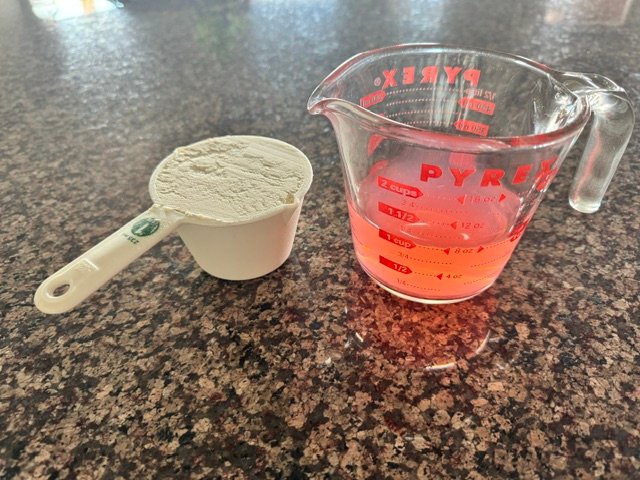
It’s About How We Measure
A dry measuring cup is made to be filled all the way to the top.
If you’re measuring flour or sugar, you can fill the cup and then level the top with the straight edge of a knife. Try doing that with milk. You’ll be cleaning the counter.
That’s why a liquid measuring cup has extra room above the measurement lines. You pour in the liquid, set the cup on a level surface and look at the measurement line at about eye level.
Same ‘cup’. Different way of getting there.
Then Why Does a Cup of Flour Weigh Less Than a Cup of Water?
Now we get to the part that causes so much confusion.
Volume is one thing. Weight is another. They are two different things.
A ‘cup’ is just telling us how much space something takes up.
An ounce on a kitchen scale tells us how much something weighs.
For example, (approximations):
1 cup of water weighs about 8.3 ounces.
1 cup of all-purpose flour weighs around 4¼ ounces.
1 cup of honey weighs around 12 ounces.
They all take up roughly the same amount of space — one cup — but they certainly don’t weigh the same.
Oh, And Then We Have This “Fluid Ounces” Thing
Let’s make things interesting. Let’s throw some fluid ounces into this conversation.
A fluid ounce measures volume (again), not weight.
There are 8 fluid ounces in 1 U.S. cup.
So when a recipe calls for 8 fluid ounces of milk, it means one cup of milk by volume.
But if something weighs 8 ounces on your kitchen scale, that does not automatically mean you have one cup of it.
Same word — ounce — but two different measurements.
No wonder this gets confusing.
One Little Catch — Flour
There is one more reason recipes can come out differently even though a cup really is a cup.
How you fill that cup matters, but only in certain circumstances.
If you scoop a measuring cup directly into a bag of flour, you can pack considerably more flour into it than if you lightly spoon the flour into the cup and level it off. The measuring cup isn’t wrong. We just managed to stuff more flour into it.
That’s why serious bakers often weigh flour instead. (I myself do this when making my Sourdough Bread. By weight, not volume. It’s a hydration thing).
So Let’s Cut To The Chase. Here’s the Simple Version
A cup of dry ingredients and a cup of liquid are the same volume.
We use different measuring cups because they’re easier and more accurate for different jobs.
And don’t confuse fluid ounces, which measure volume, with ounces on a scale, which measure weight.
So, we might have strayed just a bit from that original ‘cup’ question here, but hopefully we’ve cleared up a couple of other confusing things along the way.
So the next time somebody tells you a dry cup isn’t the same as a liquid cup, you can tell them:
“Actually, a cup is a cup. It’s the stuff we put in it that changes.”
Simple is not where you start, simple is where you arrive!