Let’s Grow a Tree
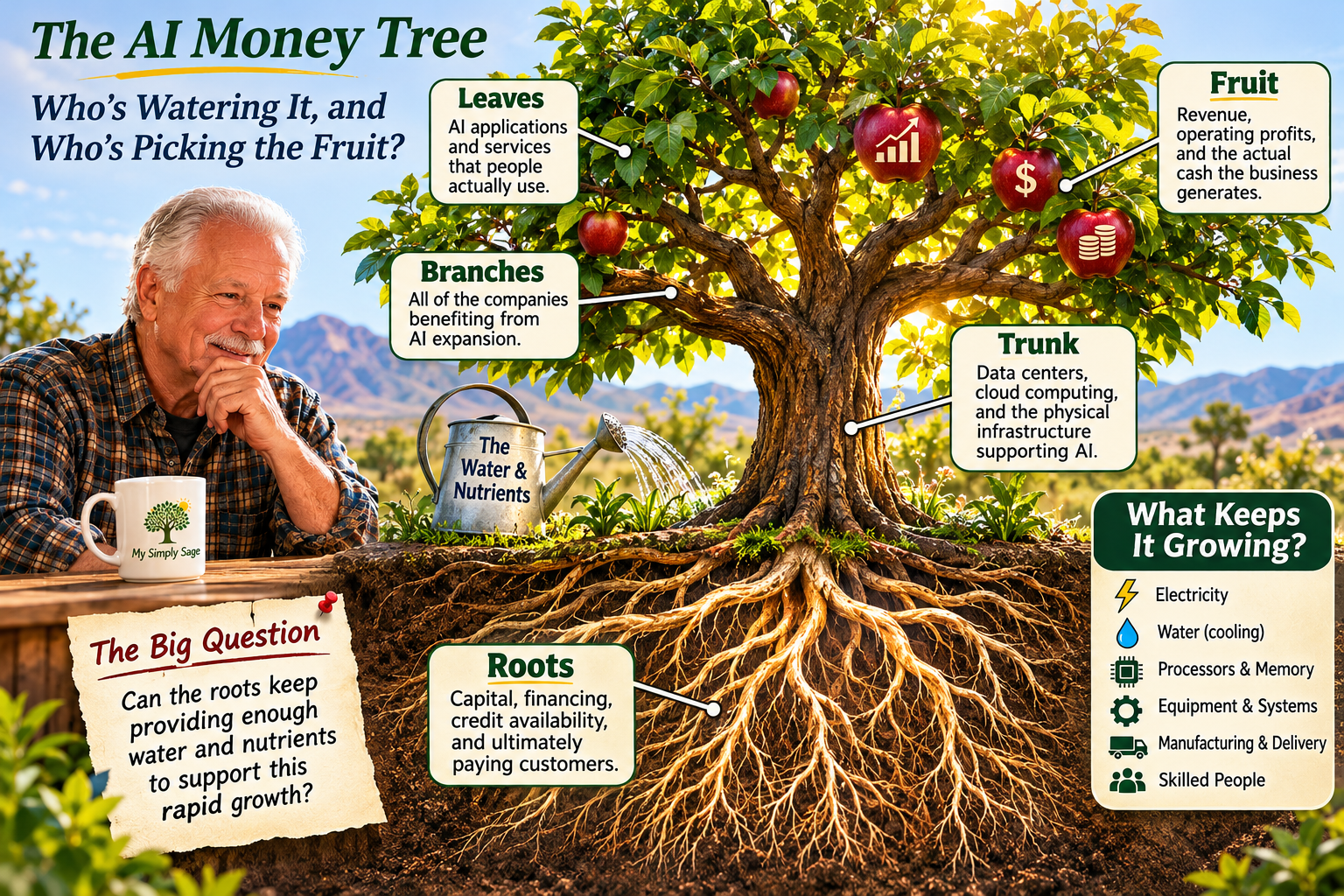
Imagine, for a moment, that the entire AI industry is a tree.
Not a little tree, either. This thing is growing like crazy!
New branches are appearing everywhere. The leaves are getting bigger, and everybody is talking about the wonderful fruit it’s eventually going to produce. Investors are excited. Companies are excited. Governments are excited. Everybody wants a piece of that fruit.
But wait a minute.
I’ve been around long enough to know that trees don’t grow simply because somebody wants them to. They need a few things. Good soil. Healthy roots. Water. Nutrients. Sunshine. And a little patience doesn’t hurt, either. So let’s take a closer look at our AI money tree.
🌳 The AI Investment Tree
Roots: Capital, financing, credit availability, and ultimately paying customers.
Trunk: Data centers, cloud computing, and the physical infrastructure supporting AI.
Branches: All of the companies benefiting from expansion.
Leaves: AI applications and services that businesses and consumers actually use.
Fruit: Revenue, operating profits, and the actual cash the business generates.
First, Let’s Look at the Roots
You can’t see the roots of a tree, but they’re pretty important. Without healthy roots, that beautiful tree isn’t going to last very long. Our AI tree has roots, too. They’re made up of money. Not just money from investors buying stocks, but money businesses actually use to build data centers, manufacture equipment, hire employees, and develop new technology. Some of that money comes from profits they’ve already earned. Some comes from investors. And some comes from borrowing.
Something to think about. What happens when a company keeps borrowing money to grow, but the money it’s earning doesn’t keep up?
Eventually, somebody wants to be paid back. And just like a tree with unhealthy roots, problems can begin developing long before anybody notices something wrong with the branches. And that’s one of the things I’ve been watching.
Now, Who’s Watering This Quickly Growing Tree?
Here’s where our tree gets really interesting. All those enormous AI data centers require electricity.
Lots of electricity.
And depending on how they’re designed and cooled, they may also require substantial amounts of water. Then there’s the equipment. Computers need processors. Processors need memory. Data centers need electrical systems, cooling equipment, and connections to the outside world. And somebody has to manufacture, deliver, install, and maintain all that equipment.
Many companies are involved in different parts of this enormous operation. Some make processors. Others make memory or networking equipment. Still others provide the electrical equipment needed to keep everything running. Think of these businesses as helping supply the water and nutrients our tree needs. But here’s the interesting part.
What happens if the tree starts growing faster than the available water and nutrients can support it?
You can have all the money in the world, but if there isn’t enough electricity available to operate your new data center, you’ve got a problem. If you can’t get the equipment you need, you’ve got another problem. And if the cost of building everything keeps climbing, somebody has to pay for that, too. Suddenly, growing our tree becomes a little more complicated.
And What About the Fruit?
Now we come to what I think is the most important part.
Why are we growing this tree in the first place?
To produce something useful, of course!
In the case of AI, that means technology people and businesses are willing to pay for. AI is already doing some pretty remarkable things. It’s helping researchers, assisting doctors, improving manufacturing, writing computer programs, and making everyday tasks easier. Heck, I use it myself, and I’ve learned a tremendous amount in the process.
But there’s a difference between something being useful and somebody making enough money from it to pay all the bills.
Consider this.
A company spends billions building data centers. Another company makes billions selling the equipment. Still another makes billions supplying electricity and infrastructure. Everybody seems to be doing wonderfully. But eventually, the businesses operating those data centers need paying customers. Enough paying customers to cover their operating expenses, repay what they’ve borrowed, replace worn-out equipment, and hopefully make a reasonable profit.
Otherwise, who’s actually paying for all this growth?
That’s the question I keep coming back to. And it’s not a question with a simple answer.
A Beautiful Tree Can Still Have Problems
Have you ever seen a tree that looked perfectly healthy, only to discover later that something was going wrong underground? The leaves looked fine, sort of. The branches were growing, sort of. Everything appeared wonderful. But the roots were struggling. And without healthy roots, even the most beautiful tree can eventually come crashing down. Our AI money tree could face similar challenges.
The companies selling equipment might be reporting record sales while some of their customers are having difficulty earning enough money to justify all their spending. Now, this doesn’t mean the AI industry is going to fail. Far from it. I think we’re witnessing some remarkable technological developments. But even a wonderful new technology doesn’t automatically make every company involved a wonderful investment. History has shown us that more than once.
So, Is Our AI Tree Healthy?
That’s what makes this whole subject so fascinating.
Parts of the AI industry are already producing substantial revenue and profits. Other parts are still developing, with enormous amounts of money being spent in anticipation of future business. Some companies may become extraordinarily successful. Others may struggle. And some may disappear entirely. Nobody knows exactly how all this will turn out. (And boy, if you can predict the future, I want to get to know you!) Certainly not the fellow on Facebook promising to make everybody rich!
But we can learn something by watching what’s actually happening. Are businesses earning real money? Are they borrowing more than they can reasonably repay? Is there enough electricity, water, equipment, and skilled labor to support continued growth?
And perhaps most importantly, are the customers who ultimately use AI willing to pay enough to keep the whole operation financially healthy?
Those questions won’t tell us exactly what a stock will do tomorrow. But they might help us understand what’s happening today. And that’s a pretty good place to start.
And that brings me back to our Facebook advertisement.
About That Mystery Stock
Remember the fellow who wanted everybody to buy before November 6th? He was promising an extraordinary return on a stock he wouldn’t even identify without getting you to request it.
Well, maybe the company is legitimate. Maybe it has some interesting technology. But how would we know? We weren’t told enough to investigate it. And that deadline?
There may be perfectly legitimate financial events happening around that date, but the advertisement didn’t explain what November 6th had to do with the mystery stock. It simply told us to hurry.
I don’t know about you, but when somebody wants me to spend my money and tells me not to ask questions, that’s usually when I start asking more questions. And there’s something else.
Even if the mystery company turns out to be a perfectly good business, that doesn’t mean its stock is a good investment at today’s price. Those are two entirely different things.