

Let’s Talk Photos, Phones and Photography
by Cary and Patty ~ My Simply Sage
I’ve been an amateur photographer for many years. I still have some of my cameras and even a digital cassette recorder. In days past, I had my own darkroom and equipment to make enlargements up to 20 inches. Do I still use all of that? Nah.
There are much better and easier ways today to capture that picture you want. And it really is pretty easy.
Today’s technology has taken a lot of the skill and knowledge that was once needed to produce a good photograph and put much of it right into the camera. The device collects all kinds of information, makes adjustments and does it all in milliseconds.
Is this a good thing?
Well…probably.
It allows regular people to capture images that in the past might have taken considerable time and knowledge to create. And it has put that ability into a handheld device that you can simply point and shoot.
An added benefit is that we can still turn those digital images into actual printed photographs — the kind some of us still enjoy holding in our hands and keeping around.
But first, let’s talk about the image itself.

What Is a Picture? What Is a Photograph?
Technically, a picture can be almost any visual image — a drawing, painting, sketch, photograph or even a screenshot.
A photograph is more specific. It is an image captured with a camera, originally on film and today usually with a digital sensor.
So all photographs are pictures, but not all pictures are photographs.
Ah, okay.
But to some of us photographers, there was always a little more to it than that.
A picture was a captured image. Nice enough.
But a photograph — well now!
That was the one where all of the special things came together. The character of the image. The lighting. The composition. The subject.
Getting those things right is what, to me, turns a captured image into a photograph.
You’ve all seen one. The picture that makes you stop and say:
“Wow. That’s a great shot. How did you do that?”
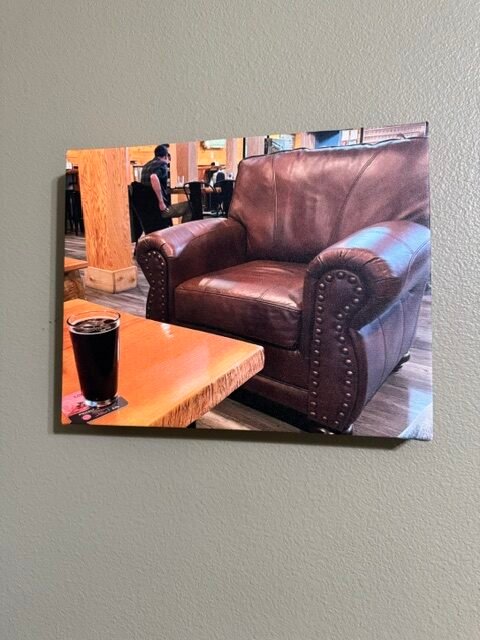
This is a photo I took of a chair that a now-departed friend used to sit in at the local speakeasy. It’s now been turned into a canvas that hangs on our wall.
Nothing special, unless you know the story. But it does get people asking the question, “What is this, and why?”
A good photograph just might do that.
So enough of the theory and blah, blah, blah.
Let’s get to what I think are three simple things worth remembering. Do these and you’ll be well on your way to capturing the photographs you really want.
1. Don’t Be Afraid to Take Lots of Pictures
A mentor told me something many years ago that stuck with me:
The picture you didn’t take today would probably have been the best one you could have gotten.
Back then, taking lots of pictures meant buying and processing roll after roll of film just to find out whether you got the shot.
Today? Take the picture.
Take another one.
And maybe another.
So you end up with a lot of pictures. Some are mediocre and some are downright bad.
Don’t worry about it. Delete the bad ones. You don’t like them anyway.
But then there it is.
That one.
The one you’re really glad you took.
Taking all those pictures just paid off.
2. Now, Take a Few Seconds to Compose the Picture
Learn to compose your picture.
This doesn’t have to mean studying photography for six months. Sometimes it only takes a few extra seconds to look at what is actually in front of you.
Look at the light.
Look at the background.
Look at where your subject is in the picture.
Maybe move yourself a few feet. Maybe move the subject. Maybe zoom in a little and get rid of all the stuff that doesn’t belong there.
A scene haphazardly snapped is just that.
But a few seconds of forethought about the light, background and placement of the subject can turn a throwaway picture into a remembrance preserved in time.
And don’t get overly concerned about all the camera settings. Today’s phones and cameras take care of an awful lot of that for us.
Concentrate on the picture.
3. Get Rid of the Ones You Don’t Want
With today’s phones and cameras, we can literally take hundreds of pictures in a day.
And that creates another problem.
We keep them all.
People used to keep photographs partly because every print represented film, processing, money and effort. We didn’t take 50 pictures just hoping to get one good one.
Digital photography removed much of that cost, but many of us carried the old “don’t throw photographs away” instinct right into the digital world.
The difference is that today we might take 40 pictures trying to get one photograph — and then keep all 40.
Now we don’t have to.
When I’m out taking pictures, at the end of the day I look through the images I’ve collected.
The ones that immediately make me say, “Nah,” I delete.
If your first impression doesn’t strike you right off, chances are it’s never going to make the cut anyway. Get rid of it. There’s not much sense in trying to make something out of nothing.
After that first go-around, there may be some worth keeping that could benefit from a little editing or cropping. Maybe a slight change in the lighting. Okay, keep those for possible future use.
And then we find them.
The one or two pictures that are the photographs we were really trying to get that day.
Those I save in a special folder for the day’s event so I can actually find them again.
And That Brings Us to Another Problem

Getting good photographs really isn’t that difficult anymore.
For a lot of people, the difficult part is looking at a picture and saying:
“Yep. That’s not very good.”
And then actually deleting it.
Keeping hundreds or thousands of pictures we don’t really want makes them harder to organize and harder to find. It also uses storage space on our phones, computers and in that mysterious place we keep hearing about called the cloud.
And that’s where this gets interesting.
There was a time when taking and keeping a photograph was pretty easy to understand:
Film → negative → darkroom or off to the processor → print → photo album or shoebox.
We knew where the photograph was because we could actually hold the darn thing in our hand.
Today it might be:
Camera → digital image file → phone or computer → Photos app → cloud → and then, where the heck did my picture actually go?
Well, we can figure that out.
But that’s for another day.
For now, enjoy your camera. Take lots of pictures. Throw away the bad ones. Keep looking for that special image nobody else has ever captured quite the same way.
And who knows?
Maybe someday you’ll become the next Ansel Adams.
Simple is not where you start. Simple is where you arrive!